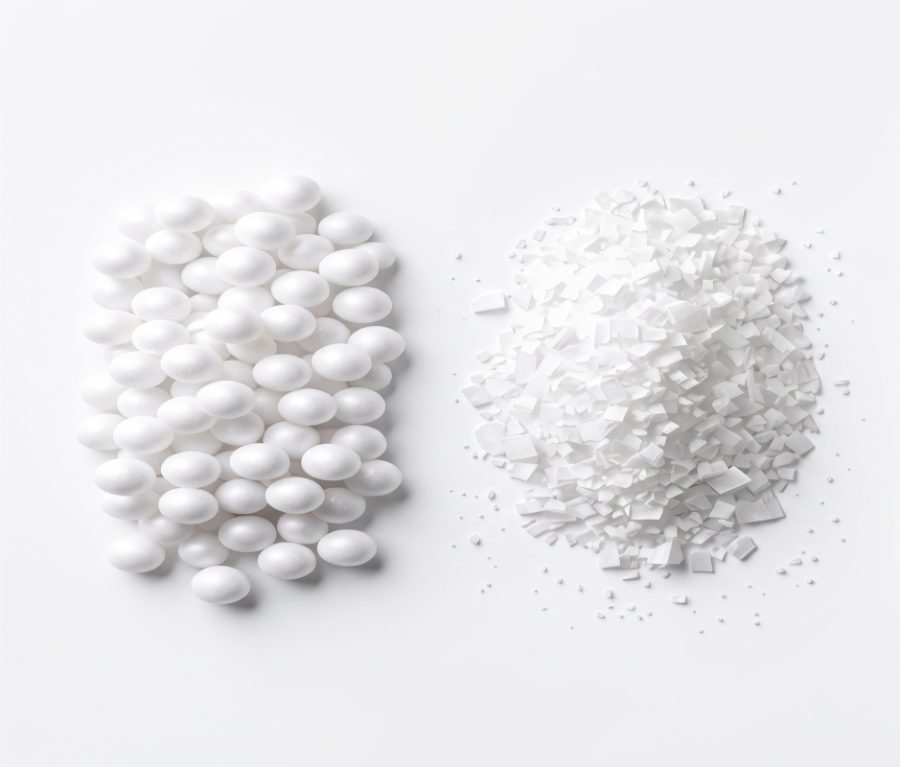



Sodium hydroxide is sodium hydroxide regardless of its physical form — flakes, pearls, and solution are chemically the same alkali. The choice between them comes down to how your operation stores, handles, and doses the reagent, not the chemistry itself.
Flakes are the traditional solid form: dense, relatively easy to bag and transport, and a common choice where dry storage is straightforward and dosing happens through a solid feeder or manual addition point. They dissolve readily but require a dissolution step before they enter solution-based dosing systems.
Pearls (also called beads or prills) offer the same solid-handling advantages as flakes with a more uniform particle size, which some operations prefer for consistent flow through automated feeders and reduced dust generation during handling.
Solution (typically supplied at a standard concentration) skips the dissolution step entirely — it is ready for inline dosing the moment it arrives, which matters for circuits where dosing accuracy and response time are tightly controlled. The trade-off is shipping weight: you are paying to transport water along with the reagent.
GGI Chemicals supplies all three forms, so the decision comes down to your site's storage capacity, dosing equipment, and logistics — not a compromise on purity or performance, since the underlying chemistry does not change.